Ukraine Strikes Crimean Bridge Again as Russia Reports Record Drone Swarm
Ukrainian officials claim critical damage to the road and railway link, while Russian authorities report 1,441 drones entered the country overnight.
By Ricardo Brooks ·

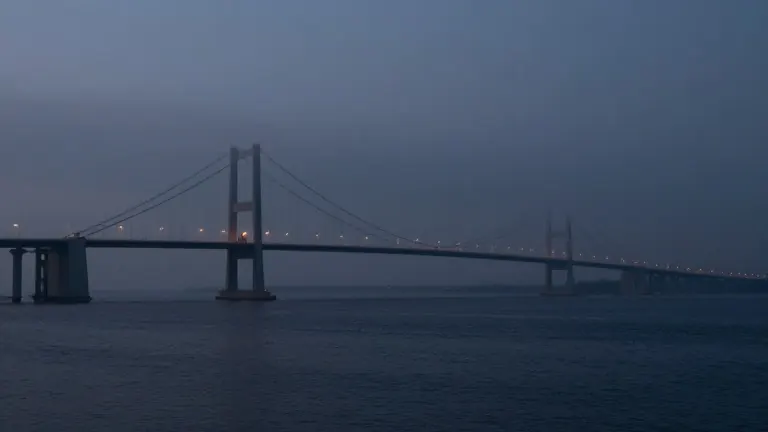
Ukraine attacked the Crimean bridge for the second night in a row on Monday, targeting a structure that has served as a primary supply route for Russian forces since the 2022 invasion began. Kyiv stated that the operation resulted in serious structural damage, while Russian officials confirmed that vehicle traffic was suspended.
Sergey Aksenov, the Moscow-appointed head of the occupied peninsula, announced the suspension of traffic in a Telegram post on Monday night. He later reported on Tuesday morning that two people were killed in a drone strike near Kerch in the Lenin district, close to where the bridge connects to Crimea. Mikhail Razvozhayev, the governor of Sevastopol, also urged residents to delay travel across the span.
Ukrainian President Volodymyr Zelenskyy confirmed the strike and described it as the seventh phase of a multi-week operation. He said Ukraine employed a mix of drones and missiles, including a precision-guided FP-5 Flamingo cruise missile, to hit the target. Zelenskyy noted that Russia has rejected prior de-escalation proposals while continuing to strike Ukrainian infrastructure in regions such as Zaporizhzhia and Dnipro.
The Fire Point company, which produces the cruise missile used in the attack, stated that the strike caused critical damage. A senior official said that nearly 900 feet of road surface was destroyed and one of the bridge's two arches collapsed. Ukraine's General Staff reported that the roadway is out of action for vehicles, while the railway section remains standing but has a damaged arch.
Russian authorities opened a terrorism case into the incident, according to the federal Investigative Committee. Deputy Prime Minister Marat Khusnullin briefed President Vladimir Putin on the developments before he departed for China, where he is scheduled to meet with Chinese President Xi Jinping and U.S. President Donald Trump. Kremlin spokesperson Dmitry Peskov did not rule out a connection between the attacks and the upcoming trilateral meeting.
Russia's Defense Ministry reported that Ukraine launched 1,441 drones into the country overnight, one of the largest attacks of the war. The ministry stated that drones were downed over 21 regions, including Moscow, occupied Crimea, the Black Sea, and the Sea of Azov. Moscow Mayor Sergey Sobyanin said 800 drones were launched toward the capital, with 321 destroyed on approach.
Rosaviatsiya, Russia's federal air transport agency, imposed temporary flight restrictions on all four of Moscow's international airports. Restrictions were also placed on airports in Kaluga, Penza, Saratov, Cherepovets, Samara, Ulyanovsk, Yaroslavl, Orenburg, Bugulma, Kazan, Nizhnekamsk, Cheboksary, Ufa, and Tambov.
Ukraine's air force reported that Russia launched 306 drones, 92 of which were jet-powered, along with ballistic and cruise missiles. Defenders downed 205 drones and three air-to-ground missiles, with impacts recorded at 44 locations. Kyiv Mayor Vitali Klitschko said Russian ballistic missiles targeted the Northern and Southern bridges over the Dnipro River, suspending traffic while damage assessments were conducted.
The State Emergency Service of Ukraine reported that at least two people were killed and one injured in the strikes on Kyiv. Regional authorities said at least three people were killed in Chernihiv, one person was killed and 31 wounded in Zaporizhzhia, and one person was killed in Vinnytsia. Widespread power outages were reported in Dnipro and the wider Dnipropetrovsk region.
Poland's Operational Command stated that air defense assets were activated in response to the Russian attacks, which also affected western Ukrainian regions including Lviv, Rivne, Ternopil, and Chernivtsi. Russia's Defense Ministry said its overnight strikes targeted military, transport, and energy facilities in the Kyiv, Zaporizhzhia, Cherkasy, Dnipropetrovsk, and Kharkiv regions, as well as port infrastructure in the Odesa region.