Crimea Bridge Road Span Submerged
Ukraine’s latest strike sinks 200 meters of the crossing, forcing all land traffic onto rails and threatening supply lines to 2 million residents.
By Ricardo Brooks ·
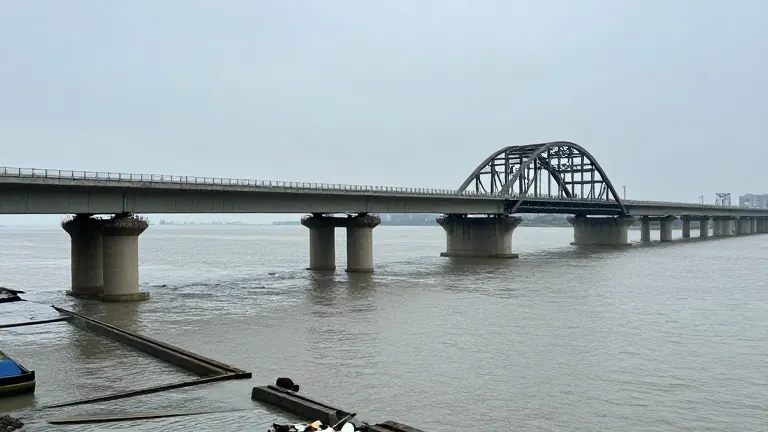
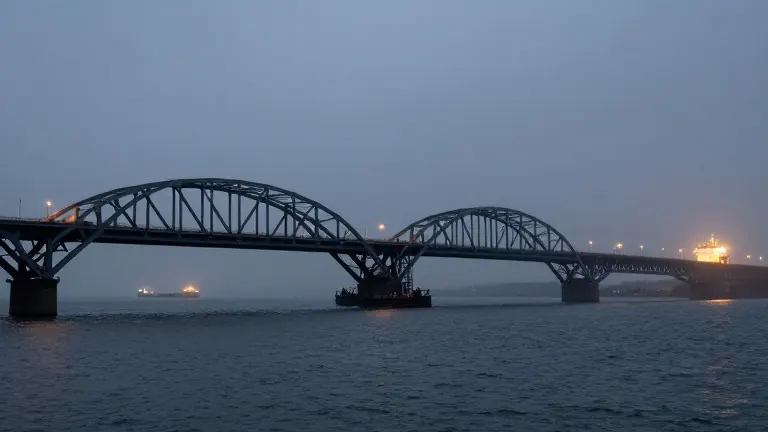
A missile and drone campaign launched over the weekend sent more than 200 meters of the Crimea Bridge’s road deck into the Kerch Strait, marking the most severe damage to the structure since its completion in 2018. The attack, conducted in waves on November 16 and 17, submerged the asphalt and steel roadway into nine meters of water and scattered debris across the shipping channel. While the rail line remains operational, the loss of the road span eliminates the primary vehicle route connecting the Russian mainland to the peninsula.
The $4 billion bridge, completed in 2018 under Vladimir Putin’s direction, served as the sole direct land link for people and supplies until Russia’s full-scale invasion began in February 2022. Since that conflict started, the crossing has become a central symbol of Moscow’s control over the region. This incident follows earlier attacks, including a 2022 truck bombing repaired in five months and a 2025 underwater drone strike that caused minimal structural harm. This time, the damage targets the connecting elements where the arches attach, a vulnerability identified by Ukrainian aviation engineer Konstantin Kryvolap.
Experts assess the impact as structurally profound. Brian Clark, a former US naval officer and naval operations expert at the Hudson Institute, stated that the damage appears to have compromised the bridge’s structural integrity. Sam Rigby, an engineering professor at the University of Sheffield, described the attack as markedly different because it targeted a larger span with higher structural complexity. The Ukrainian military command noted that Russia built a myth around the bridge as a symbol of Crimea being "Russian forever," adding that part of the structure now lies underwater.
Logistical challenges have intensified for the 2 million residents in Crimea and the hundreds of thousands of Russian military personnel stationed there. With the road span gone, trains must carry all traffic until repairs are complete. Ukrainian forces have recently increased drone strikes against cargo trucks on the M-14 coastal highway, the alternate route Russia secured after capturing Mariupol. On November 17, Ukrainian forces also damaged another major bridge linking Crimea to Rostov-on-Don via the port of Taganrog, further straining the region’s transport network.
Repair timelines are expected to extend well beyond six months, with many experts predicting a duration of over a year. David MacKenzie, a senior technical director with COWI, explained that a new span must be built on the Sea of Azov shoreline, floated to the site, and lifted into place because the railway blocks transport from the Black Sea. This fabrication site lies within 300 kilometers of Ukrainian-held territory, exposing workers to drone and missile threats for months. Clearing the wreckage from the strait could take one to two weeks, depending on weather and security conditions.
Authorities must decide whether to restore maritime or road traffic first, as temporary road access cannot coexist with shipping. Mike Petersen, a former senior US naval adviser, warned that Ukraine could contest every salvage attempt, potentially extending the closure indefinitely. In the short term, bad weather forced the cancellation of all ferry traffic across the strait on November 18. Local residents reported panic buying and fuel lines, while officials maintained that food prices remained stable and the new span would be stronger than its predecessor.