Iran hits US radar sites in Bahrain as three carriers deploy
Teheran strikes a third American target in days while Washington consolidates naval power in the Gulf and Hormuz shipping remains under pressure.
By Amit Ricci ·
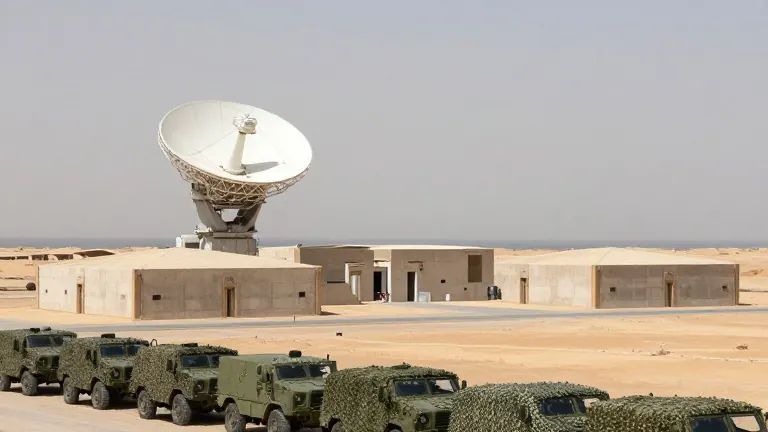
Iranian drones crossed the Persian Gulf on Tuesday to strike a United States radar installation in Bahrain. It marked the third direct attack on American military targets in the island kingdom within a short span, signaling a shift from a two-month pause in regional hostilities. Bahrain’s air defenses intercepted the incoming craft, and officials described the operations as successful.
The strikes target the operational capacity of US bases rather than just the assets within them, according to Mostafa Najafi, a security analyst based in Teheran. He told The Associated Press that Iran has moved toward a more active and preventive strategy aimed at countering threats in their early stages. This approach follows US airstrikes on Iranian communication towers and persistent drone surveillance, which Teheran cites as the cause for the retaliation.
The attacks land as the US Central Command confirms the arrival of the USS Theodore Roosevelt carrier strike group in the region. This addition brings a third carrier to the area, joining the USS George H.W. Bush and the USS George Washington. The move places thousands of additional troops and naval vessels under President Donald Trump’s command, who is weighing his next steps in a conflict that began nearly nine months ago.
A report from Israel’s Institute for National Security Studies notes that combined US naval assets in the Gulf, Arabian Sea, Red Sea, and Mediterranean now exceed the force deployed during the initial joint US-Israeli strikes on February 28. The expanded presence provides greater offensive firepower and missile interception capabilities. The USS George Washington has been deployed for approximately six months, having been moved from the Asia-Pacific region to relieve the USS Abraham Lincoln.
Negotiations to end the war remain stalled despite intensified mediation efforts by Qatar. Hamidreza Azizi, a senior Iran analyst at the International Crisis Group, published an analysis on X stating that recent military events have complicated the path to a negotiated deal. He wrote that the risk of renewed war now depends on whether Teheran decides that the cost of containment is higher than the risk of escalation. Azizi noted that Iranian leaders are weighing if breaking the blockade through escalation is less expensive than accepting its continuation.
Sascha Bruchmann, a defense analyst at the International Institute for Strategic Studies based in Bahrain, said the attacks indicate Teheran is losing patience with a waiting game as economic problems mount. He told AP that while shooting at ships creates fear, it is not effective enough to change the strategic equation. "I don't overestimate what we saw against Bahrain this week. This is not yet," he said.
Mahdi Mohammadi, an advisor to Iran’s influential parliamentary speaker, posted on social media on Monday that leaders view US economic pressure as an effort to create an internal "security crisis." He stated that the attacks on Bahrain were intended to prevent the gradual expansion of enemy operations and to impose costs on their military infrastructure. Iranian officials have described the current situation as one of "neither war nor peace" and promised it must end.
Shipping routes remain under threat. Iran continues to attack vessels transiting the Strait of Hormuz, a waterway that carried about one-fifth of the world’s traded oil and gas before the conflict. The UK Maritime Trade Operations agency reported on Tuesday that a tanker was attacked twice north of Oman, with the second hit causing a fire. Fars news agency also reported that two ships were hit by mines in the strait, though it was unclear if one of these was the tanker reported by the UK agency.
In Yemen, Iran-backed Houthi rebels have consolidated control of the Bab el-Mandeb strait, which connects the Gulf of Aden to the Red Sea. This follows a withdrawal over the weekend by a Saudi-backed group aligned with the Yemeni government, a setback for the anti-Houthi coalition. Two Yemeni military officials said those forces are now fortifying defenses in areas leading to the southern city of Aden, the interim capital of the internationally recognized government. The officials, who spoke on condition of anonymity, said efforts are focused on deploying more troops and equipment in and around the Tur al-Baha district in Lahij province.