Regulators Mandate Cyan Lights for Driverless Vehicles
The National Highway Traffic Safety Administration proposes a national standard for blue-green marker lights to distinguish autonomous vehicles from human-driven cars.
By Eduardo Salazar ·
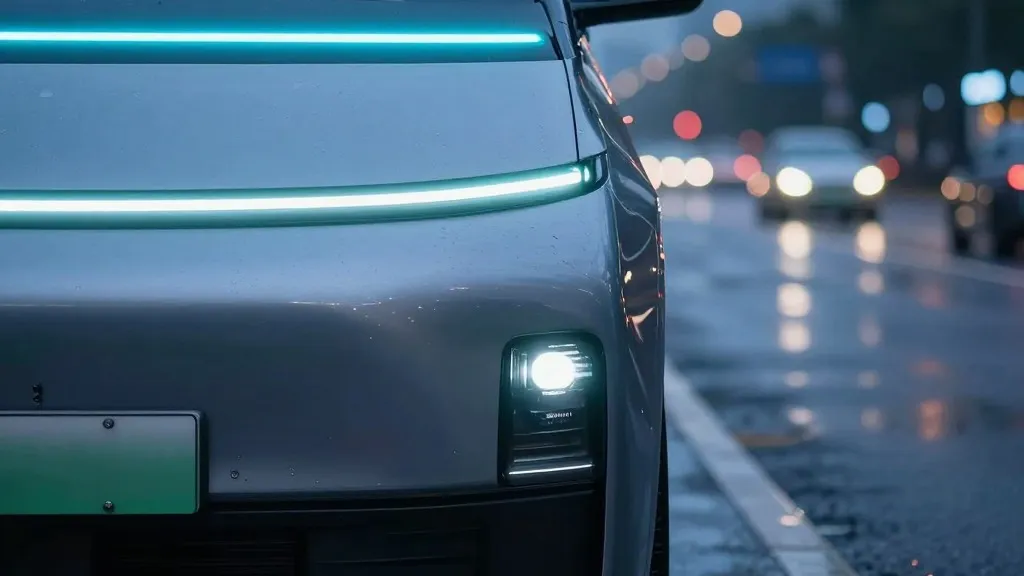
The National Highway Traffic Safety Administration has proposed a new federal standard requiring driverless vehicles to utilize cyan-colored marker lights to indicate that an automated system, rather than a human, is in control. Released on October 23, 2026, the proposal marks a decisive shift in how federal regulators intend to manage the visual communication between autonomous vehicles and the rest of the traffic ecosystem. By designating a specific blue-green hue, NHTSA aims to eliminate the ambiguity that has surrounded driverless car signaling for years.
The agency is rewriting Federal Motor Vehicle Safety Standard No. 108 to accommodate the unique design requirements of vehicles without human drivers. The primary goal is to create a uniform signal that law enforcement officers and other road users can instantly recognize. The choice of cyan is deliberate, intended to fill a visual gap in the current color spectrum. Since red, amber, white, and flashing blue or red lights are already assigned to brakes, turn signals, headlights, and emergency vehicles, a distinct blue-green light offers a clear alternative that reduces the risk of confusion on the road.
While the proposal establishes a national framework, the cyan lights will remain optional for manufacturers. However, if automakers choose to implement them, the new rules will dictate specific standards for color, brightness, and placement. This approach seeks to prevent a fragmented market where different companies use varying signals, thereby ensuring that any vehicle adopting the technology does so in a consistent and legally compliant manner. The standard is designed to be adopted uniformly by major players in the autonomous space, including robotaxi operators like Waymo, Nuro, and Zoox, as well as traditional automakers such as GM and Mercedes-Benz.
There is some precedent for this type of signaling, though its history is mixed. Mercedes-Benz previously obtained state-level approval for turquoise lights on its Level 3 Drive Pilot vehicles, although the company later abandoned that specific plan in favor of a Level 2++ system. NHTSA’s move suggests a desire to codify a broader national standard that transcends individual corporate strategies or state-level experiments, providing a stable regulatory environment for the entire industry.
Alongside the lighting proposals, the agency is streamlining other aspects of vehicle certification that no longer apply to driverless designs. The proposal seeks to remove requirements for physical hazard switches, manual beam shifters, and internal turn levers, controls that are redundant when no human is operating the vehicle. Additionally, NHTSA is updating the 12.8-volt testing standard to allow for modern LED architectures, removing administrative hurdles that complicate the integration of current technology. The agency is also reconsidering rules that dictate the physical positioning of high-beam lights relative to low-beam lights.
This regulatory update is part of a larger Department of Transportation effort to facilitate the deployment of autonomous vehicles by reducing the burden of legacy controls, such as steering wheels and pedals. However, the path to smoother integration is not without friction. Regulators continue to enforce existing rules strictly, as evidenced by a recent audit query into the Tesla Cybercab. NHTSA is examining the technical data Tesla used to certify the vehicle, specifically questioning the absence of sideview mirrors, pedals, and a steering wheel, all of which are currently required under FMVSS. This juxtaposition highlights the ongoing tension between establishing new standards for future vehicles and enforcing existing rules on present ones.
Source: The Verge