US forms unit to block Iran land routes
Task Force Iron Gate will coordinate with agencies to stop weapons transfers via land and the Caspian Sea.
By Ricardo Brooks ·
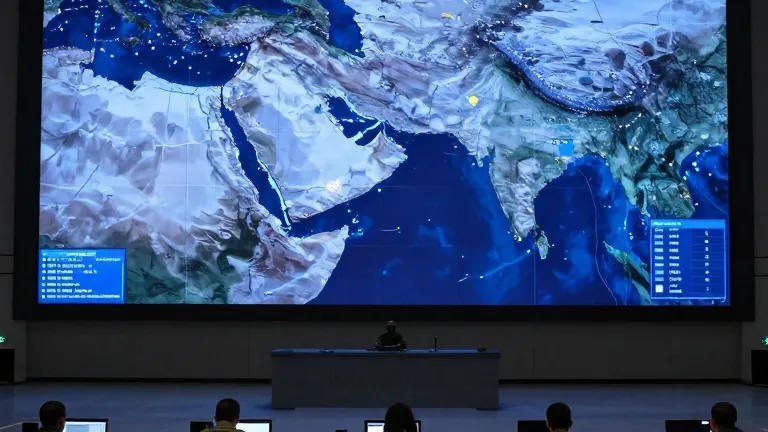
The United States military established a new operational unit on Saturday to intercept the transfer of advanced weaponry and materials entering Iran by land and across the Caspian Sea. US Central Command announced the creation of Task Force Iron Gate as tensions rise regarding a potential expansion of the conflict with Tehran.
The unit will operate from Tampa, Florida, and consists of approximately twenty civilian and military personnel. Its mandate includes coordinating with other US government bodies to monitor the movement of weapons systems, dual-use technologies, and sanctioned goods across Iran's seven land borders. The task force is also tasked with tracking illegal revenue streams moving through the region.
Admiral Brad Cooper, the commander of US Central Command, stated that the new body reinforces the existing naval blockade. He described the unit as a measure to maintain the "success of our ironclad blockade against Iran at sea" while addressing gaps in ground-based logistics.
The announcement coincided with plans unveiled by the Islamic Revolutionary Guard Corps on the same day. The IRGC detailed the construction of underground complexes designed to sustain missile and drone manufacturing during aerial bombardment. These plans follow satellite imagery showing construction activity near known missile bases and previous Iranian assertions that US strikes had failed to eliminate subterranean facilities.
Michael Mulroy, a former US deputy assistant defence secretary for the Middle East, explained that the task force aims to identify entry points for weapons and methods for disrupting energy transport. He noted that if President Donald Trump escalates military operations, the focus would likely shift to economic and infrastructure targets rather than purely military sites. Mulroy characterized the unit as a coordination body intended to intensify economic pressure by targeting ground routes that complement the established maritime controls.
Tehran reacted with skepticism. Sardar Mohebi, a spokesman for the IRGC, dismissed the initiative as "just a play on words" through the Fars news agency. He argued that Washington's goal of collapsing the Iranian economy through severe pressure had previously failed to materialize within the two-week timeframe predicted by US officials.
Analysts observe that the task force targets supply networks linked to Russia, even though Central Command did not explicitly cite that connection. Reports indicate that Russia has shipped drone components and explosives to Iran via the Caspian Sea, with some claims suggesting Russian technology aids Tehran in developing supersonic cruise missiles. Mahjoob Zweiri, a professor at Qatar University, warned that these reports represent a "real concern" and that the new US unit could provoke a confrontation with Moscow.
Rami Khouri of the American University of Beirut questioned the feasibility of sealing Iran's borders, noting the country's long history as a trading nation. He stated that it is "virtually impossible for the US to seal off every one" of Iran's regional contacts. Khouri pointed out that materials for Iranian weapons are often sourced from other nations, including the US and Europe, and routed through Asian companies.
Joe Kent, a former counterterrorism official who resigned in March, criticized the move on social media. He accused Central Command of undermining diplomatic efforts led by the vice president. Kent described the action as "policy by CONOP" and noted that Admiral Cooper and Defense Secretary Pete Hegseth are among officials urging Trump to resume attacks on Iran.
Zweiri suggested the task force may be largely symbolic because the US lacks a military presence on the Caspian Sea. He argued that littoral states such as Azerbaijan and Armenia are unlikely to cooperate for fear of upsetting Russia. The Caspian region accounts for only 11 percent of Iran's economy, a figure Al Jazeera could not independently verify, though the Soufan Center notes it represents a fraction of overall maritime trade.