El Niño rains trigger record Atacama Desert bloom in Chile
Over 200 species are flowering in the driest nonpolar desert on Earth after the heaviest rainfall recorded since the 1950s.
By Olga Menon ·
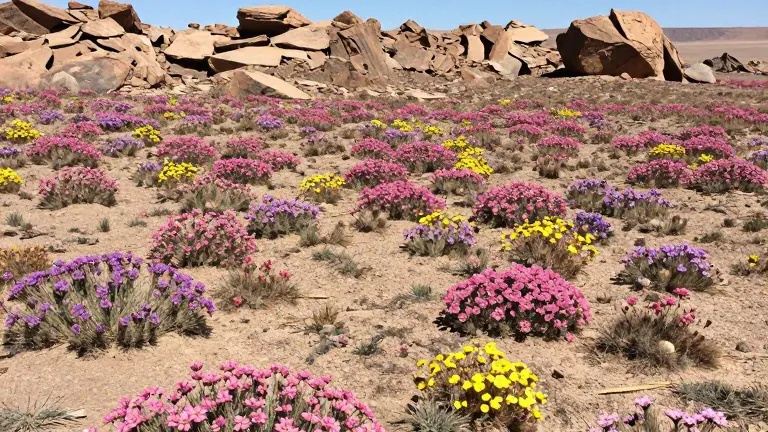
More than 200 plant species are currently in full bloom across a vast stretch of Chile's Atacama Desert, marking the largest floral display recorded in the region in three decades. The surge in vegetation follows the heaviest rainfall measured in the area since meteorological records began in the 1950s.
The intense precipitation, driven by the El Niño super cycle, caused flash floods in July and August that damaged or destroyed dozens of homes. The events forced hundreds of residents to evacuate their homes. The rainwater penetrated deep into the parched earth, awakening millions of dormant seeds, bulbs, and tubers that had remained hidden under the sand for decades.
The initial emergence of plants created a pale-yellow haze across the desert floor a month ago. This was followed by a soft purple hue as additional bulbs germinated. Now, nearly every indentation and crevice in the landscape is streaked with pink, yellow, lilac, and purple. Scientists note that flowers are blooming in patches where they have never been documented before, suggesting that bulbs have lain dormant in these locations since the phenomenon was first studied in detail in 1997.
Moisés Grimberg, the administrator of Llanos de Challe National Park, described the event as a natural seed bank transforming into a living archive. He emphasized that the species are in a race against time, as their life cycle lasts only two to three months. The park, which spans 113,000 acres along the arid coastline, typically receives about 10,000 visitors annually. However, 15,000 tourists have visited in the last few weeks alone.
Chile's national tourism board projects the region will see approximately 300,000 overnight trips during the two-month blooming period. The star attraction is the garra de león, a crimson flower with flame-like green leaves that grows along just a few miles of the coastline. This endemic species is found nowhere else in the world and is coaxed out of dormancy by the rare rains.
Biologists from the Instituto de Investigaciones Agropecuarias, Chile's national seed bank, are collecting specimens to analyze in their laboratories before the season ends. Ana Sandoval, a biologist with the organization, is shaking seeds free from their casings to send to taxonomists in northern Chile. She noted that the desert is not empty but waiting for the right conditions to awaken. The seed bank aims to preserve the genetic material and unique adaptations, such as fine hairs and thick waxy cuticles, that allow these plants to survive extreme aridity.
The blooming creates a transient ecosystem where insects hatch and attract lizards, bats, and larger mammals such as the guanaco. While the phenomenon has occurred every few years in the past, scientists say it is becoming more frequent due to climate changes bringing unseasonal rains. A national park dedicated to the bloom was created in June 2023 to protect a 141,000-acre area where the flowers spring up.
Miguel Vargas, the governor of the Atacama region, is beginning the process of seeking UNESCO World Heritage recognition for the phenomenon. He stated that the designation would strengthen special interest tourism and diversify a regional economy currently reliant on mining. Vargas hopes the Atacama region will become Chile's eighth World Heritage site within a couple of years. The bloom is projected to last until mid-November.