Tiny snail spreads to southern Michigan waters
The New Zealand mudsnail, a microscopic invader that can outcompete native species, has been detected in a Kent County tributary for the first time.
By Amit Ricci ·
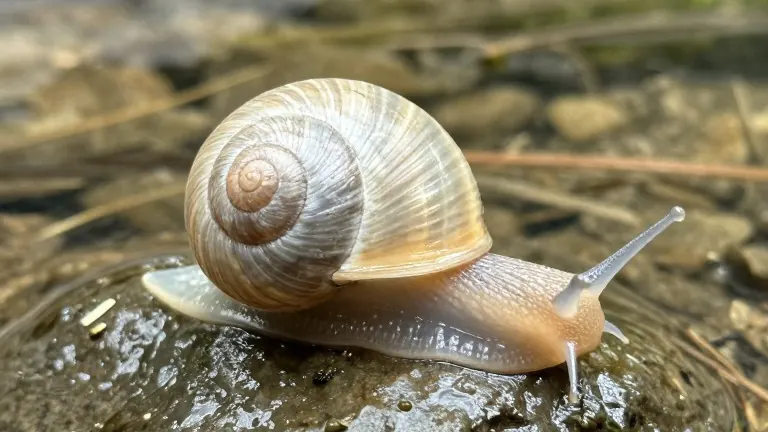
A microscopic snail has appeared in a new part of Michigan.
The New Zealand mudsnail was spotted in Bear Creek, a tributary of the Thornapple River in Kent County. This discovery marks the first time the species has been confirmed in the southern Lower Peninsula. The find occurred during a volunteer monitoring event organized by the Coldwater River Watershed Council. Scientists will now analyze the population genetics of the samples to determine how the animals arrived in this new area.
The snails are remarkably small, with multiple individuals able to fit on a pencil eraser. Despite their size, they pose a severe threat to local ecosystems. They can reproduce asexually, meaning a single female can establish a population without a mate. Michigan populations appear to consist entirely of females. One snail can clone itself into 200 offspring per year. In parts of the western United States, densities have reached 300,000 snails per square meter.
Jen Koop, an invasive species biologist at Northern Illinois University, noted that the creatures are difficult to detect until they are established. "Once they are in an aquatic system, they are here to stay," Koop said. "We currently have no means of eradicating them or even mitigating their effects." They compete with native snails for food and can clog pipes and drainage systems when they reach high numbers.
The arrival of the mudsnails adds stress to waterways already dealing with zebra and quagga mussels. Donna Kashian, a director of environmental science at Wayne State University, explained that the mussels deposit nutrient-rich waste on the stream floor. This creates ideal habitat conditions for the mudsnails. The combination of invasives can reduce the zooplankton available to sport fish like trout.
The species is native to New Zealand and arrived in the Great Lakes in 1991, likely via ballast water. It has been spreading for over a century. A single female can start a new colony through asexual reproduction, which makes containment difficult. The snails also possess a trapdoor-like shell structure that allows them to survive digestion in fish, meaning they can pass through a predator alive.
The Michigan Invasive Species Program advises anglers to clean, drain, and dry all equipment between water bodies. This includes waders and boots. The New Zealand Mud Snail Collaborative recommends using separate gear for known infested areas and using freezing or hot water to kill hitchhikers.
Source: Michigan Public