Police made 980 arrests after Saturday's street fights in France
Police deployed 70,000 officers to prevent a repeat of last weekend's chaos, but violence still erupted in Paris, Marseille, and Lyon.
By Ricardo Brooks ·
A new cycle of street unrest has gripped France, with authorities detaining nearly 1,000 individuals after Saturday’s nationwide demonstrations turned violent in multiple cities. The protests, driven by grievances over the cost of living and school conditions, drew hundreds of thousands of participants before evening clashes forced police to intervene.
Interior Minister Laurent Nuñez announced late in the day that 980 people had been arrested, a figure he expects to rise. He reported two serious injuries, one in Toulouse and another in Clermont-Ferrand. The ministry estimated the total turnout at 410,000, although trade unions claimed the number was closer to 800,000. To maintain order, approximately 70,000 police officers were deployed across the country, a substantial increase aimed at preventing a repeat of the previous week’s disorder.
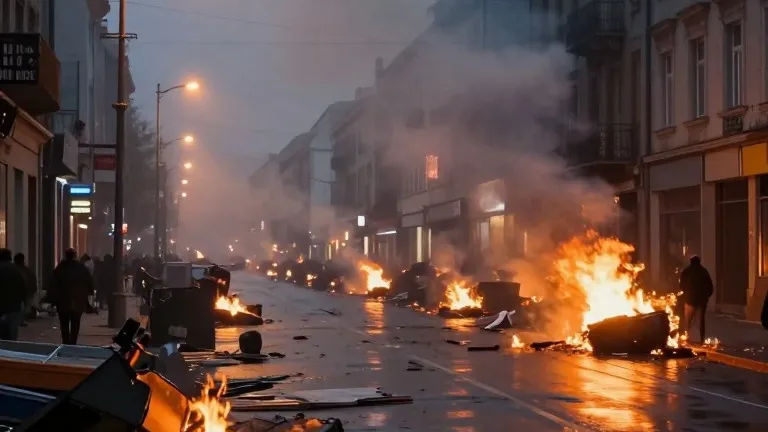
In Paris, a march that began peacefully at Porte d'Italie devolved into conflict near Porte de Vincennes. Police charged masked groups with batons as protesters threw projectiles and smashed the windows of a car dealership. Nuñez stated that several thousand radical activists positioned themselves at the rear of the march, including around 500 identified rioters. In Marseille, demonstrators set fire to rubbish bins and used metal sheets to block streets. In Lyon, officers fired tear gas at a crowd that had gathered in an area declared off-limits by the local prefecture.
The government had earlier restricted demonstrations to those organized by recognized trade unions following a week of severe looting and arson. Hundreds of individuals have already been jailed through fast-track court hearings. Despite these measures, violence persisted. In Bordeaux, people tore boards from a shop, while in other locations, barricades were set ablaze. The authorities noted that the scale of the unrest was contained compared to the previous weekend, when over 2,500 arrests were made and damage was estimated in the hundreds of millions of euros.
Protesters expressed deep frustration with the government. Zelie, a 26-year-old demonstrator in Paris, told the BBC that people were "suffering a lot" and that "it's been too much." Two masked teenagers described their generation as feeling abandoned, with one blaming "poverty and the violence of the police" for the looting. Separately, about 13,000 people rallied peacefully in Orléans against the National Rally party.
The unrest extended beyond French borders. Riot police used tear gas against anti-government demonstrators in Tirana, Albania, while clashes were reported in Brussels. In Milan, hundreds of soldiers and police blocked gathering spots to prevent a repeat of last week's violence. With presidential elections six months away, leading contenders have begun blaming President Emmanuel Macron and his ministers for the instability.
Last weekend, roughly 550,000 people marched against rising fuel prices, leading to the worst disorder in France's modern history. More than 1,000 police officers were injured, and one demonstrator lost a hand to a crowd-control grenade. The current protests mark a continued challenge for Macron's administration as it seeks to stabilize the nation before the upcoming vote.
Source: BBC News