Milwaukee’s Late Ballot Count May Flip Wisconsin’s Gubernatorial Race
Nearly 59,000 absentee votes processed in a single batch at a new central facility could erase a Republican lead by morning.
By Amit Ricci ·
A sudden shift in Wisconsin’s gubernatorial race is expected Tuesday night as the city of Milwaukee prepares to report nearly 59,000 absentee ballots in one large batch. Because these votes are not included in the initial in-person tallies, the statewide results may show a Republican lead that vanishes by Wednesday morning. The process is a known procedure in the city, but it often fuels confusion and controversy when the numbers swing sharply in favor of Democratic candidate David Crowley.
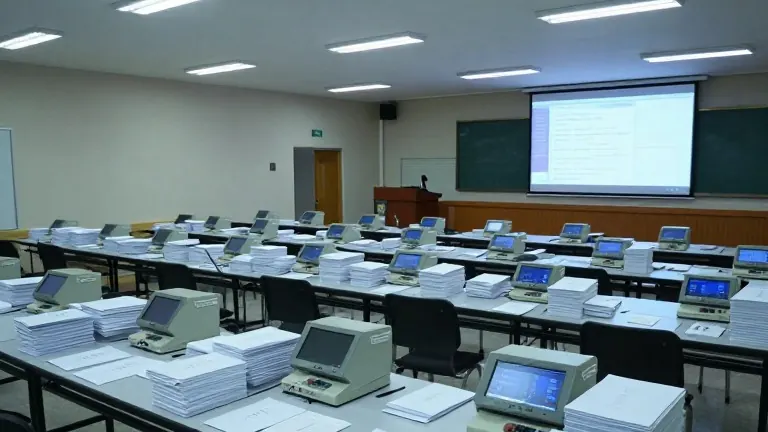
The Milwaukee Election Commission has moved its central count operation to the Italian Community Center at 631 E. Chicago St. for the first time. The city chose this location after finding that the larger Baird Center used in 2024 required too much walking for the roughly 130 election workers assigned to the job. The compact layout of the new facility allows observers to monitor the entire process more efficiently. This central count method is used by 42 municipalities in Wisconsin to streamline the processing of absentee ballots.
As of 11:20 a.m. on Election Day, 58,993 of the 64,852 issued absentee ballots had been returned. Most arrived through the city’s in-person early voting program. The final count will be known shortly after polls close at 8 p.m., as ballots continue to arrive via mail, drop boxes, and direct delivery. Wisconsin law prohibits officials from counting these ballots before Election Day, so the results will only be entered into the statewide system once the deadline has passed.
Political analysts predict the Milwaukee absentee vote will split approximately 80 percent for Democrats and 20 percent for Republicans. If that projection holds, Crowley would receive about 47,200 votes while Republican Tom Tiffany would get 11,800. This net gain of 35,400 votes could allow Crowley to overtake Tiffany, who might appear to lead by 30,000 votes earlier in the evening. The late arrival of these results is a recurring feature of Wisconsin elections, having similarly affected the U.S. Senate races in 2020 and 2022.
The operation has not been without minor issues. Two election workers failed to assign voter numbers to about 240 ballots from Ward 216 on the city’s South Side. MEC Executive Director Paulina Gutiérrez confirmed that the absentee board of canvassers reviewed the error and deemed the ballots eligible. She noted that the workers were coached and remained on the job. The commission has also implemented stricter procedures to verify data transfers, following a similar clerical error during the August 2026 primary.