Detroit's Houdini Haunting: A Century of Mystery
A century after the magician died in Detroit, the city continues to search for his ghost, with a new séance planned for Halloween.
By Ricardo Brooks ·
The magician who convinced the world he could escape any trap could not escape death in Detroit on October 31, 1926. One hundred years later, the city where Houdini performed his final show remains haunted by the circumstances of his demise.
Houdini performed in Detroit nineteen times between 1894 and 1926, rising from a bottom-of-the-bill act to global fame. He built his reputation on daring escapes, such as jumping from the Belle Isle Bridge in 1906 while bound in handcuffs. While reports at the time indicated the river was not frozen, later movies portrayed him leaping into ice, a detail that persisted in popular imagination despite historical records.
By 1914, Houdini had developed his signature act, the Water Torture Cell, a coffin-sized box filled with water. Dorothy Young, who toured with him as a stage assistant at age 17, recalled the tension of the performance. "Mrs. [Houdini] always stood in the wings because they had a secret code in case he couldn't get out," Young told NPR in 2004. She was the last surviving person to have worked with the magician before her death in 2011.
Houdini's death likely resulted from an incident in Montreal shortly before his Detroit engagement. A college wrestler challenged Houdini to take punches to the stomach. Houdini usually braced his abdominal muscles, but the wrestler struck him before he could prepare. Young noted the lack of preparation in the moment. "And to think those boys didn't give him a chance to get himself protected," she said.
Houdini suffered severe pain and was advised to rest, but financial pressure forced him to keep his Detroit contract. Jeremy Dimick, a curator at the Detroit Historical Museum, described the final performance at the Garrick Theater. "He doesn't have the strength to put his makeup on before the show, and he's kind of collapsing during the intermissions of the show," Dimick said. Houdini was carried from the theater to Grace Hospital, where doctors discovered a ruptured appendix.
He underwent two surgeries and died on Halloween. The physical locations associated with his final days have largely disappeared. The Garrick Theater and Grace Hospital are gone, as is the hotel where he stayed. The Hamilton Funeral Home, which embalmed him, became a girls' art school. In 2004, the then-head of the school, Juanita Hammond, showed visitors a locked storage room with an indented floor used to drain fluids from corpses. "Houdini was laid out here by the Hamilton Funeral Home, in this room here," Hammond said on a tour.
Bess Houdini, the magician's wife, spent years holding séances to contact her husband. She finally said goodnight to him on Halloween, a decade after his death. "And you remember what he always said about these things? That it was impossible for the dead to return," she said. "This proves he was right. For if it would have been possible, I would have had some sign from him in the past 10 years."
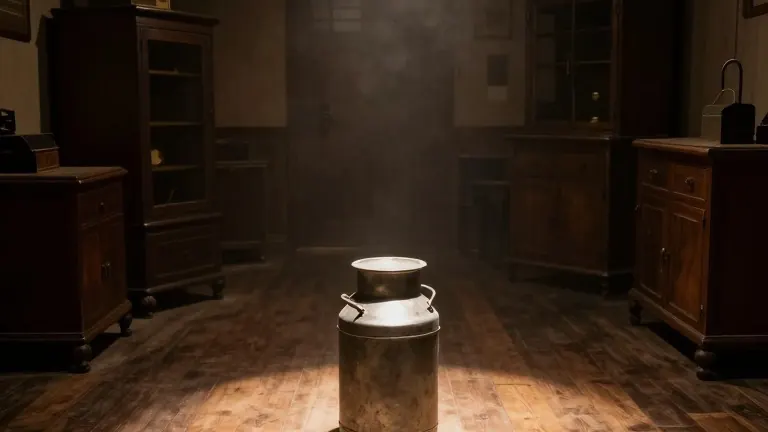
In Marshall, Michigan, about 100 miles west of Detroit, the American Museum of Magic holds an aged metal can from Houdini's workshop. John Sherwood, who curates the collection, uses the can in séances. Houdini once jumped into the can filled with warm water, locked inside with six Mastodon locks. Sherwood plans another séance this Halloween, hoping the centennial might draw the magician's spirit. "I've always said that the greatest publicity stunt that Harry Houdini ever pulled off was dying on Halloween because after that the mythology about him grew by leaps and bounds," he said.
Some participants have placed a lox and bagel sandwich in the can, appealing to Houdini's Jewish heritage. Conspiracy theories suggest his death certificate was altered to ensure he died on Halloween, or that the wrestler was a hitman sent by psychics. These theories add to the mystery that has surrounded the magician's life and death for a century.
Source: WVIZ