Zelenskyy claims flawless strike collapses Crimea bridge arch
Ukrainian drones and missiles disabled the Kerch Strait crossing, blocking grain shipments and forcing trains onto a single track during Putin's trip to China.
By Olga Menon ·
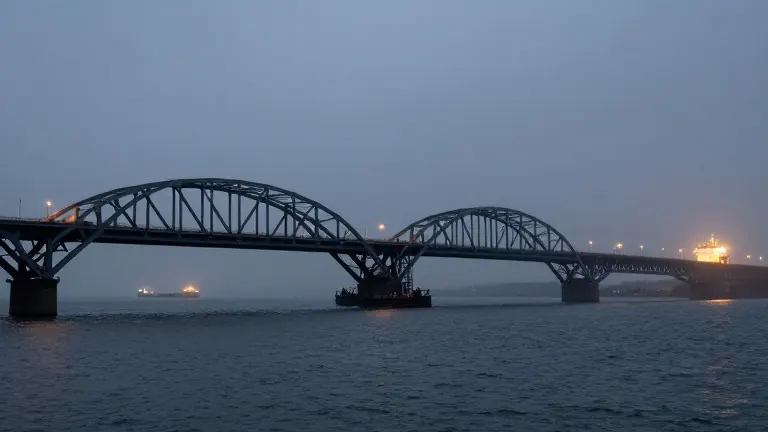
Ukrainian forces collapsed one of the massive arches of the Kerch Strait bridge on Tuesday, severing the only fixed land link between southern Russia and the occupied Crimean peninsula. President Volodymyr Zelenskyy described the operation as flawless, noting that the strike used heavy drones and cruise missiles to target the structure. The bridge, which Russian leader Vladimir Putin has long viewed as a symbol of his rule, sustained heavy damage to its roadway and rail sections.
The attack was the culmination of weeks of preparatory work by the Ukrainian military. Before the main strike, Kyiv’s forces disabled Russian air defense systems, radars, and drone jamming equipment protecting the crossing. During the night operation, domestically produced drones hit the bridge, while Neptune and Flamingo missiles targeted the rail infrastructure. Destinus, a Netherlands-based firm, confirmed that seven of its Ruta cruise missiles were part of the multistage assault.
The fallen arch now sits in the deepest part of the Kerch Strait, effectively blocking large freighters. This obstruction prevents ships carrying grain and steel from southwestern Russia and occupied Ukrainian territories from passing. Igar Tyshkevych, a Kyiv-based analyst, told Al Jazeera that the blockade further isolates Russian farmers from Black Sea and Mediterranean markets. He warned that the disruption could drive up global grain prices, stating that Crimea is becoming an island logistically.
Many Ukrainians question whether the Kremlin views the damage as a critical economic loss. Taras, a drone pilot in eastern Ukraine who withheld his surname under wartime protocol, said Putin does not worry about the financial impact on his citizens. He argued that the Russian leader struggles to comprehend the technological advancement of Ukrainian forces, believing the public will continue to suffer in silence despite the economic destruction.
The Kremlin responded with sharp rhetoric, labeling the Kyiv government a neo-Nazi junta and accusing it of escalating the conflict by striking civilian targets. Dmitry Peskov, the Kremlin spokesman, insisted on Tuesday that the bridge would be restored to be even better than before. He added that Moscow remains determined to continue the hostilities, despite the physical damage to the structure.
The 19-kilometer bridge opened in 2018 at a cost of $3.8 billion, four years after the annexation of Crimea. Its arches span 227 meters and weigh thousands of tonnes. The crossing has served as a hub for millions of tourists and tens of thousands of Russian troops since the 2022 invasion of southern Ukraine. The strike coincided with Putin’s visit to Shenzhen for the Asia-Pacific Economic Cooperation summit, where he is scheduled to meet with Chinese President Xi Jinping and United States President Donald Trump.
Foreign observers offered a more sober assessment of the military impact. Nikolay Mitrokhin, a researcher at Germany’s Bremen University, noted that there has been little movement of military personnel or supplies along the bridge for the past year, with only occasional gas truck columns passing. He suggested that Zelenskyy should have focused on commissioning more mid-range drones to block roads in occupied regions along the Sea of Azov, arguing the current attack was counterproductive in military terms.
Russia launched counterattacks on the same day, damaging two of the five bridges across the Dnipro River in Kyiv. Previous strikes on these crossings have paralyzed road and subway traffic, causing severe congestion for residents. Bridges in four other Ukrainian regions have also been damaged or destroyed recently. Aleksey Kushch, another Kyiv-based analyst, said these attacks fit a new Russian strategy targeting hypermarkets, mining companies, and processing plants. He noted the aim is to create an empty economic space to decimate Ukraine’s GDP, jobs, and tax revenue.