European youth stage massive coordinated protests over cost of living and war
Tens of thousands of young people in over 20 European countries protested on Friday, demanding action on housing, education, and military spending.
By Amit Ricci ·
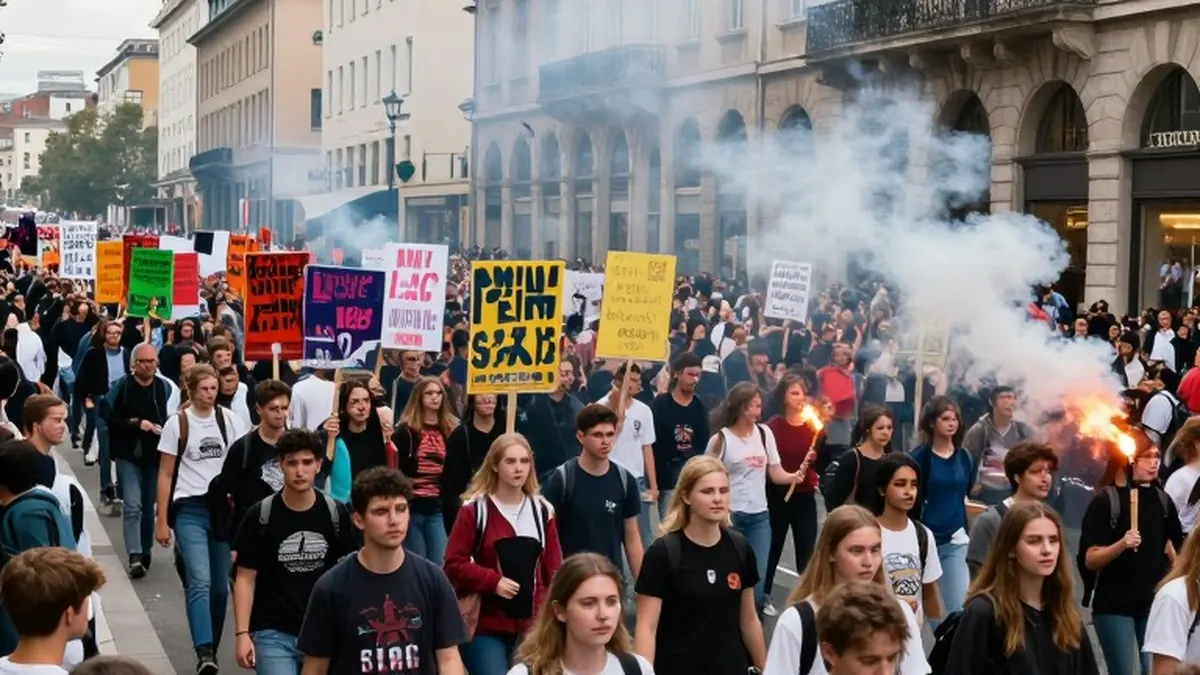
Young people across Europe took to the streets in more than 20 countries on Friday, joining a coordinated wave of demonstrations focused on the rising cost of living, housing shortages, and increased military spending. The events represent one of the largest collective actions by young people on the continent in recent years, with rallies held in approximately 400 cities.
Organized by the Youth Strike coalition, the protests featured activists from over 50 different groups. Participants in nations including Belgium, France, Germany, Greece, Italy, Portugal, Spain, and the United Kingdom waved placards bearing the slogan “fight for our future.” Some demonstrators lit flares and burned cardboard models of tanks to symbolize their opposition to militarization.
The coalition outlined five primary demands for the movement. These include ending militarization and conscription, making structural investments in education and welfare systems, showing solidarity with Palestine, advancing climate and social justice, and achieving a radical transformation of the current economic and social system.
Alessandro di Miceli, an organizer from Italy, described the purpose of the Europe-wide action as a way to claim the right to a dignified future. He noted that while specific demands varied by country, the underlying issues remained deeply connected. Leonor Chicó, a Portuguese organizer, emphasized the necessity of self-organization, stating that governments frequently demonstrate that the needs of the younger generation are not their top priority.
Shabbir Lakha, representing the UK-based Stop The War coalition, viewed the mobilization as a vital step toward creating a lasting international movement. He believes the protests are capable of uniting young people, students, and workers around shared goals.
The demonstrations follow weeks of unrest in several countries, which were initially sparked by long-running school protests in France. Governments are currently facing increasing pressure to address calls for affordable housing, functional public services, and greater social equality.
In France, the rallies included participation from the gilets jaunes, the yellow vest movement that previously shook the country in 2018 and 2019. In Germany, approximately 1,000 students gathered in Berlin to voice concerns about the potential return of compulsory military service.
Italy saw some of the largest turnouts, with tens of thousands protesting in Rome, Milan, and other cities. The demonstrations coincided with a general strike by the CGIL, the country’s largest trade union, which opposed the economic policies of Prime Minister Giorgia Meloni. The union framed the strike as a national call for change.
Laura Peritore, a 24-year-old university student, expressed frustration with the current government, claiming it is cutting healthcare and education to rob young people of their future. She vowed that the protesters would not back down. Meanwhile, in London, marchers carried banners opposing war, racism, the climate crisis, and capitalism. In Spain, the protests coincided with the anniversary of the death of former dictator Francisco Franco.
Agence France-Presse and Reuters contributed to the reporting of these widespread events.