Albanese urges Putin to end Ukraine war at Apec summit
The Australian prime minister directly challenged the Russian leader to stop the conflict in Ukraine during high-level talks in Shenzhen, China.
By Ricardo Brooks ·
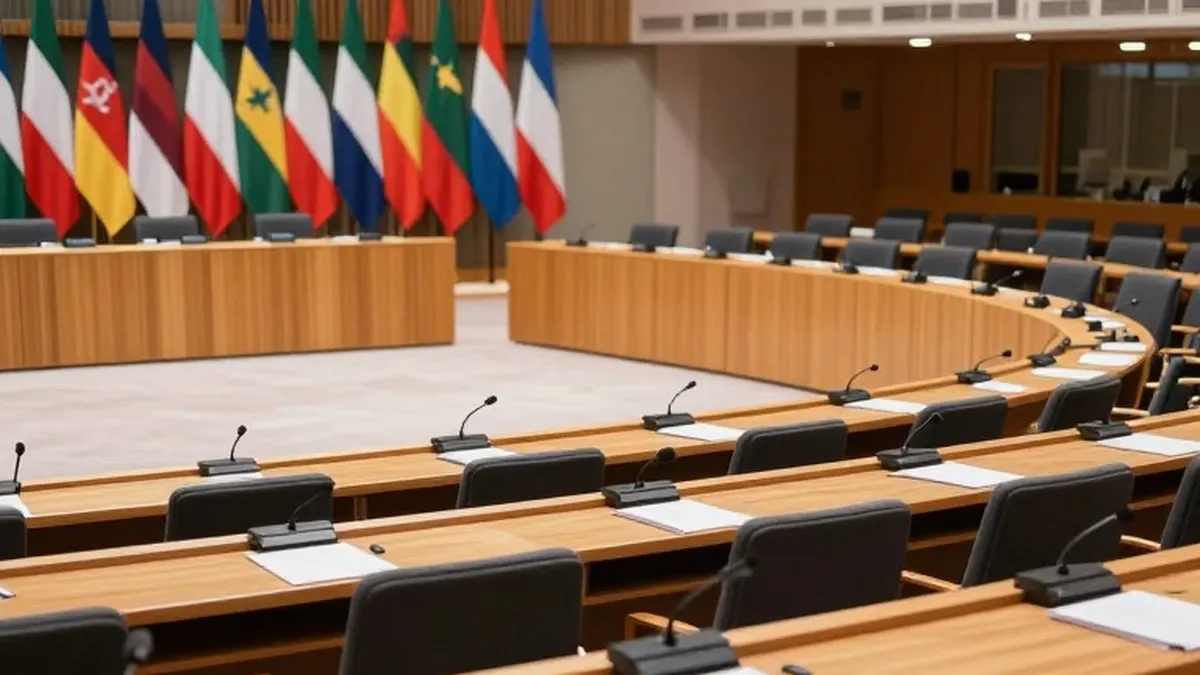
Australian Prime Minister Anthony Albanese has issued a direct challenge to Russian President Vladimir Putin, urging him to put an immediate end to the war in Ukraine. Albanese made his remarks during the Asian Pacific Economic Cooperation summit held in Shenzhen, China, addressing an audience that included more than 20 world leaders. During his intervention, the Australian leader looked directly at Putin, who was observed with his head down while listening to the address.
Albanese framed the conflict as a major driver of global economic instability. He noted that the wars in Ukraine and the Middle East are two of the most significant causes of disruption to international trade. The prime minister emphasized that the ongoing conflict in the Middle East is contributing to global inflation and increasing cost of living pressures across various economies. He stated that the international community must do everything possible to resolve these disputes.
In a pointed address, Albanese said he was speaking very directly to President Putin. He called on the Russian leader to end the war now. This direct appeal came as summit host China President Xi Jinping and US President Donald Trump were also present. The leaders were gathered in Shenzhen for the annual economic talks, which have become a focal point for geopolitical discussions.
Albanese also welcomed the upcoming three-way meeting scheduled for later in the day between Xi, Trump, and Putin. He expressed hope that the historic talks would yield positive outcomes for the global community. This tripartite meeting is being watched closely by international observers as a potential turning point in diplomatic efforts to resolve the conflict in Eastern Europe.
Ukrainian President Volodymyr Zelenskyy has warned that the Thursday summit should not be used to determine the future of his country without his input. Many commentators and European leaders have drawn parallels between this gathering and the Yalta summit held at the end of the Second World War, highlighting the significant stakes involved in the current negotiations.
Albanese faced criticism earlier in the week from Ukrainian Australians for participating in a group photograph with the Apec leaders, including Putin. However, he defended his decision by stating that he did not want to miss the opportunity to communicate his views on the war directly to the Russian leader. He viewed the platform as essential for making his position clear on the global stage.
The Australian prime minister is scheduled to meet directly with Xi Jinping on Friday. During this bilateral session, the wars in Ukraine and Iran are expected to be key topics of discussion. Following this meeting, Albanese will travel to Beijing for further talks with Chinese Premier Li Qiang and Zhao Leji, who holds the third-ranking position in the Chinese government.
President Xi addressed the summit on Thursday, reaffirming his commitment to economic development and cooperation among Apec member nations. He used a maritime metaphor to describe the group, stating that members are like passengers on the same ship. Xi argued that to navigate the waves of the Pacific, the countries must unite and look out for one another.
Analysts expect Xi to use his talks with Albanese to raise concerns about Australia's strengthening security ties with the United States. This includes discussions on artificial intelligence development and the Quad security dialogue, which also involves India and Japan. This week in Manila, Quad leaders announced new joint military exercises and a business leaders forum set to begin in 2027.
Australia's participation in these initiatives will include P8-A Poseidon and P3-C Orion maritime patrol aircraft, with a focus on monitoring China's approach to dominance in the Asia Pacific region. Albanese acknowledged the complexity of the global economy, noting that every economy present is grappling with worldwide uncertainty. He highlighted China's importance as Australia's most significant trading partner, representing more than 25 percent of the country's exports.