China's Space Program: First Pakistani Astronaut Joins Crew
Muhammad Zeeshan Ali flew to orbit alongside two Chinese colleagues on Wednesday, marking a new chapter in the bilateral agreement signed in early 2025.
By Amit Ricci ·
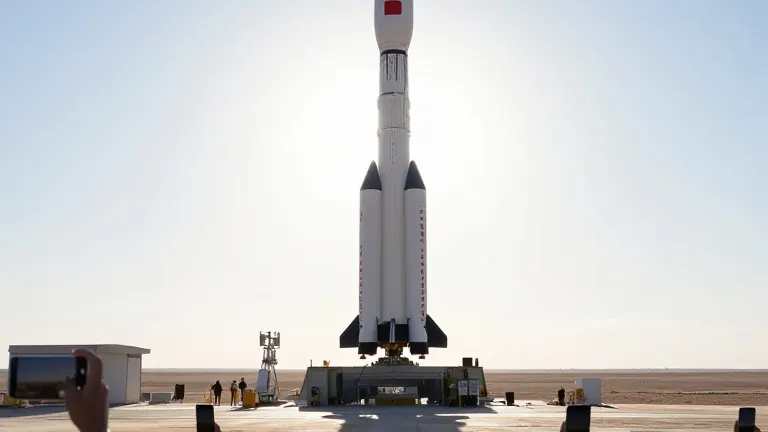
The Shenzhou 24 spacecraft lifted off from the Jiuquan Satellite Launch Center in northwestern China on Wednesday morning, carrying the first non-Chinese member of a crew bound for the country's space station. The vehicle separated from its launch rocket and entered the planned orbit without incident.
The crew consists of Pakistani astronaut Muhammad Zeeshan Ali, 40, and Chinese astronauts Tang Hongbo, 51, and Wu Yi, 39. This marks the first time a foreign astronaut has flown on a Chinese manned mission. According to Xinhua, the team will perform over 90 scientific experiments and technology tests during the flight.
Zeeshan Ali is on a short-term mission. He will conduct an experiment involving photosynthetic cyanobacteria in orbit before returning to Earth aboard the Shenzhou 23 spacecraft. Tang Hongbo has flown on two previous missions and is set to become the first person to board the Tiangong space station three times, according to national broadcaster CCTV. Both Zeeshan Ali and Wu Yi are on their first spaceflights.
The partnership stems from an agreement signed by China and Pakistan in February 2025. At the launch site, Pakistan's Minister for Planning, Development and Special Initiatives, Ahsan Iqbal Chaudhary, expressed hope for expanded future collaboration. He thanked President Xi Jinping and the Chinese engineering teams, stating that Pakistan would eventually send astronauts independently.
Pakistani Prime Minister Shehbaz Sharif shared his support on social media on Tuesday. He described the Pakistan-China friendship as surpassing the heights of the Himalayas in its journey to outer space. The launch was preceded by a send-off ceremony where crowds gathered to watch the rocket depart.
During a news conference on Tuesday, Tang Hongbo noted that differences in language and culture initially complicated training. He observed that the efforts to bridge these gaps were paying off. Zeeshan Ali demonstrated his Mandarin skills in front of reporters, quoting a poem about climbing higher to see farther. He said the next phase of cooperation should move toward multiple joint flights and missions to the Moon and Mars.
China is preparing for its first crewed lunar landing by 2030. The United States remains a primary competitor in space exploration, with NASA planning to land astronauts on the lunar surface in 2028.