US and Iran Exchange Strikes After 2-Month Lull Ends
Iran's third drone attack on a U.S. radar site in Bahrain in five days triggered a retaliatory strike on Qeshm Island.
By Ricardo Brooks ·
The two-month pause in fighting between the United States and Iran ended on Tuesday.
Iran launched a drone attack on a U.S. radar installation in Bahrain. This marked the third Iranian strike on American military targets in the Persian Gulf island kingdom within five days. The U.S. military responded by targeting Iranian assets along the Strait of Hormuz.
Bahrain reported that its air defense systems intercepted the Iranian aerial attacks. The U.S. military confirmed that the strike caused no damage to American equipment and no injuries to personnel. Hours later, a U.S. fighter jet hit a missile launch site on Qeshm Island. That site belonged to Iran's paramilitary Revolutionary Guard.
A U.S. official said precision munitions were used in the Qeshm Island strike. The official stated the U.S. was responding to aggression toward its personnel. Ahmad Nafisi, a local official, said the strike did not damage residential or commercial areas or infrastructure.
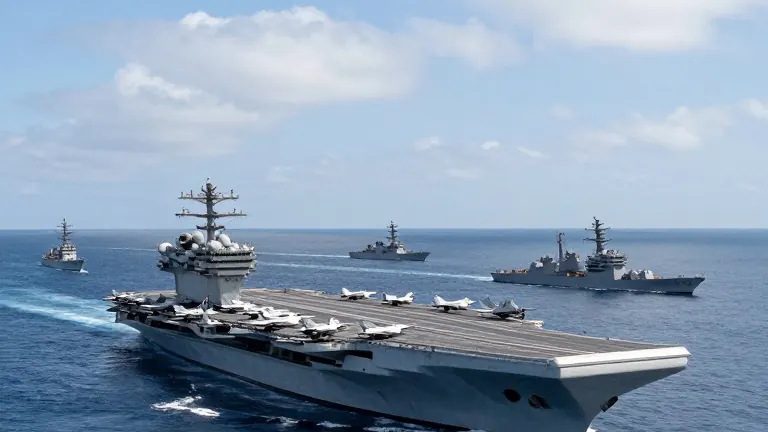
The conflict has entered its eighth month, despite President Donald Trump's initial promise that it would last only weeks. Trump has described new strikes as highly unlikely, yet he has deployed a third aircraft carrier and thousands of troops to the Middle East. He told Vice President JD Vance that talks are not needed at this time. The arrival of the USS Theodore Roosevelt means U.S. naval assets in the region now exceed those deployed when the war began on Feb. 28.
Iran has been under a naval blockade enforced by the U.S. in and around the Strait of Hormuz. This waterway is critical for global energy supplies. Iran and its proxies have disrupted shipping there since the war began. The blockade is curbing the flow of Iranian crude to the global market, which is damaging Iran's economy.
Tehran-based security analyst Mostafa Najafi told The Associated Press that Iran may be shifting its strategy. He said Tehran might be moving from a wait-and-retaliate posture to targeting the operational capability of bases. Hamidreza Azizi, a senior Iran analyst at the International Crisis Group, wrote that the risk of renewed war now depends on whether Tehran concludes the costs of restraint are greater than the risks of escalation.
Egypt, Qatar, Saudi Arabia, and the United Arab Emirates condemned Iran's attack on Bahrain. They called it a violation of Bahrain's sovereignty and a threat to regional stability. Majed Al Ansari, a Foreign Ministry spokesman for Qatar, warned in Doha that any escalation posed an extremely grave danger to diplomatic prospects. Negotiations to end the war have stagnated despite mediation efforts from Qatar.
Sascha Bruchmann, a defense analyst with the International Institute for Strategic Studies, said Tehran is growing impatient as economic woes mount. He noted that shooting at ships causes fear but is not effective enough to change the strategic equation. Iranian officials have termed the current situation no war, no peace. Mahdi Mohammadi, an adviser to Iran’s parliamentary chief, posted on Monday that leaders view U.S. economic pressure as an effort to create a domestic security crisis.
Iran continues to attack ships seeking to transit the Strait of Hormuz. In Yemen, Iran-backed Houthi rebels have solidified their control of the Bab el-Mandeb Strait. The U.S. Navy's 5th Fleet, based in Bahrain, has already sustained damage in previous attacks. U.S. Central Command has not commented on whether it plans to keep all three carrier strike groups in the region.