SS United States rests on Gulf floor
The 990-foot former ocean liner sank in a controlled operation to become the world's largest artificial reef.
By Ricardo Brooks ·
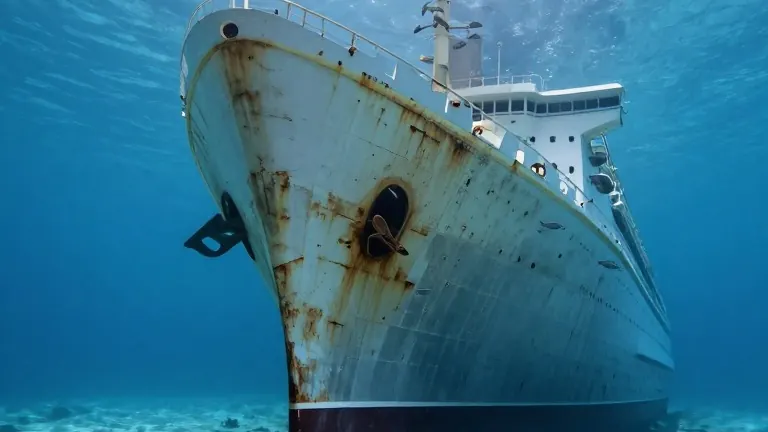
A 990-foot steel hull now lies on the seabed of the Gulf of Mexico.
The SS United States, a retired ocean liner, sank on Wednesday night to become the world's largest artificial reef. The vessel, which is longer than the Titanic, rested in an upright position 180 feet beneath the surface. The sinking concluded after hours of a slow, controlled descent. The ship disappeared beneath the waves at 10 p.m. Eastern Time.
The project transforms the ship's hundreds of rooms, corridors, and elevator shafts into a habitat for divers and marine life. Susan Gibbs, who chairs the board of the SS United States Conservancy, described the moment as a mix of grief and hope. Her grandfather, William Francis Gibbs, designed the vessel more than 70 years ago. "It's a combination of grief, that I will be saying goodbye to her in her current form, but, gratitude and hope in terms of what she will continue to give to the world," she said.
The ship holds a deep-sea history that dates back to 1952. It won the Blue Riband, a trans-Atlantic speed record, on its maiden voyage. It still holds that record more than 60 years later. The Conservancy noted that the liner could have been converted into a military transport capable of carrying 14,000 troops for 10,000 miles without refueling, though it was never used for that purpose.
During its final years at sea, which ended in 1969, the SS United States carried several famous passengers. The list included President Harry Truman, Walt Disney, Marilyn Monroe, Walter Cronkite, and a young Bill Clinton. Gibbs said the ship embodied the spirit of a nation confident in its ability to accomplish the extraordinary.
The Conservancy originally sought to turn the vessel into a hotel or museum. Legal and financial issues forced a sale to Okaloosa County, Florida, in 2024. The county decided to sink the ship to create a reef. The task required specialized engineering because the ship was designed to stay afloat.
Coleen Marine, a marine engineering firm, led the operation. President and co-founder Coleen O'Malley stated that the team preserved the ship's original design as much as possible. "We've maintained the actual hull. So she's very recognizable," O'Malley said. "We've made it so that the structure under the water is going to look like she did above the water."
The team spent more than 18 months preparing the vessel for the descent. They repaired holes in the hull to ensure a stable sinking. O'Malley explained that the critical factor was managing the air inside the ship, not just the water entering it. The crew also cleaned much of the rusted exterior to create a better environment for aquatic life. Their primary goal was to keep the ship sinking straight down without flipping or turning.
Both O'Malley and Gibbs traveled to the coast near Destin and Fort Walton Beach, Florida, to watch the final moments. They observed the ship disappear below the waves on Wednesday. The SS United States Conservancy is now planning to build a museum in Florida in the ship's honor.