Kyiv Residents Maintain Calm as Russian Attacks Damage Key City Bridges
Despite repeated missile strikes on Kyiv's infrastructure, locals continue to use damaged crossings, relying on public transport and engineering resilience to navigate the ongoing conflict.
By Amit Ricci ·
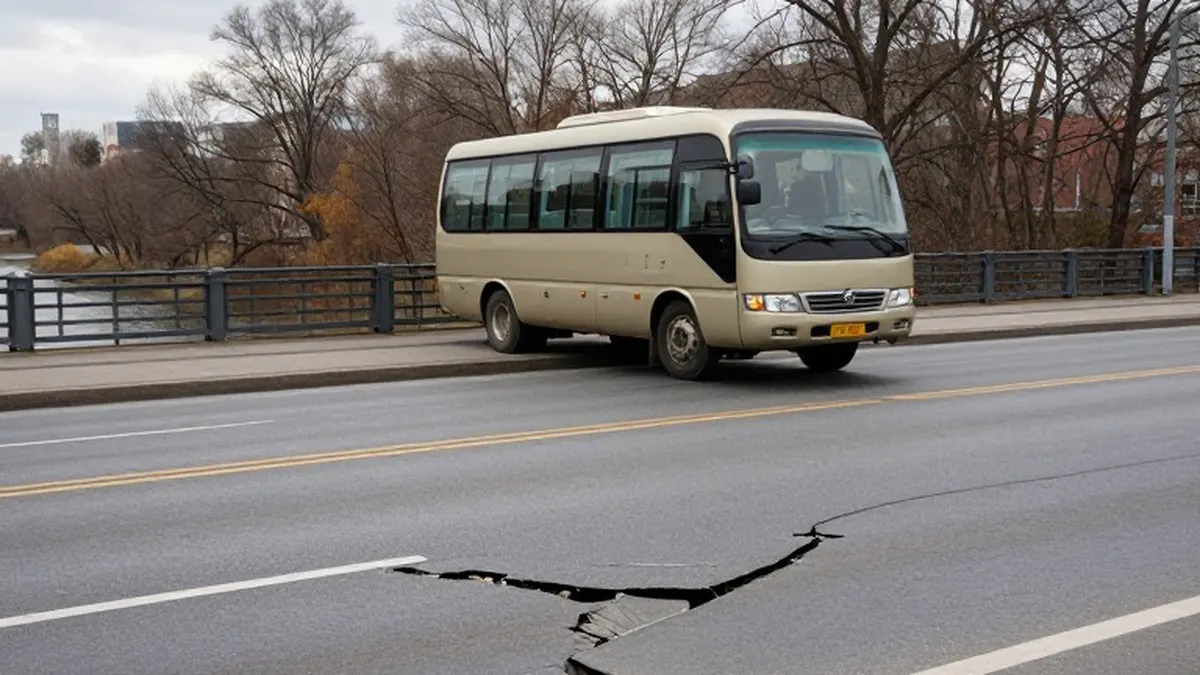
Residents of Kyiv are demonstrating a notable resilience as they continue to traverse the city’s damaged bridges following a series of Russian missile attacks. Mykola, a 65-year-old driver of a private minibus, expects to drive his vehicle 20 to 24 times daily past significant holes in the road on the Northern Bridge. These tears in the tarmac were caused by a ballistic missile strike on Tuesday. Buses are currently the only form of motorized transport permitted on this normally busy multi-lane crossing. To reach the city center, drivers must carefully navigate the single functioning lane, skirting around the damage.
Mykola, who operates a marshrutka, expressed confidence in the structure's integrity. He noted that the bridge has not collapsed and that those with knowledge of bridge construction understand the limits of the damage. By lunchtime on Tuesday, the holes had been covered, likely to prevent passengers from looking down at the Dnipro River below. The drivers of these vehicles are known for their multitasking abilities, often chatting, smoking, and collecting fares while driving quickly to compete with rivals. Passengers pay a cash fare of 25 hryvnia, and one individual usually assists the driver in handling change.
Russia has targeted Kyiv's bridges since early October, aiming to sever the connection between the western city center and the eastern residential areas, which are home to roughly a third of the population. This week saw two additional strikes. The first on Tuesday coincided with Ukraine's partial destruction of the Kerch road bridge to Crimea. The second occurred on a noisy Thursday night, shortly after Vladimir Putin promised a more painful response to the damage of his pet project.
As of Friday, traffic restrictions were in place across the city. The Southern Bridge allowed motor traffic only from east to west, while the new Podilskyi Bridge, damaged early Friday, had similar limitations. Mayor Vitali Klitschko advised citizens to avoid car travel following a night in which six people were killed. The Northern Bridge remains open for public transport, cyclists, scooter riders, and pedestrians, although many must contend with damp late autumn weather and missile alerts.
Engineering experts suggest that the Northern Bridge, a suspension structure, is difficult to destroy completely. Dmytro Bespalov, a transport planning expert at Kyiv’s National University of Construction and Architecture, explained that such bridges have strong construction and high repairability. While the roadway suffered damage, the supporting structures remained unscathed. Russia is believed to have targeted the supporting pylons with ballistic missiles, a precise but difficult attack similar to the one used against the Kerch bridge.
However, Bespalov warned that Kyiv remains strategically vulnerable if Russia uses dozens or hundreds of missiles, as the city did not have sufficient bridge capacity before the war. In 2021, Kyiv ranked third in Europe for congestion, behind Istanbul and Moscow. A major concern is the planned use of floating pontoon bridges as a backup. These structures have lower capacity and are more vulnerable to attack. Bespalov noted that it would take 20 pontoon bridges to match half the current capacity and that they would likely be unusable during missile or drone alarms.
At a busy bus stop on the eastern bank, residents Nataliya, 40, and Iryna, 39, expressed optimism about adapting to the difficulties of war. Nataliya, a customer service specialist, said that after the initial discomfort of the first 24 hours, people tend to adapt. Iryna added that despair is what the enemy wants, and since bridges can be rebuilt, the primary goal is to ensure no civilians or military personnel are nearby during attacks.
Oleksandr, a 42-year-old construction worker waiting to cross, acknowledged that if the bridges were fully destroyed, he and his wife would move to her parents' home across the river. They have prepared for this scenario by installing a generator, digging a water well, and converting the heating system from gas to wood-burning. This practical approach reflects the broader attitude of Kyiv's residents, who are managing electricity shortages and the lack of heating while facing daily attacks, including a recent drone explosion near the Dutch embassy.
The city continues to operate under these constraints, with people focusing on solving immediate problems rather than worrying excessively about future threats. This mindset is crucial as the full chill of winter arrives and the infrastructure continues to undergo repairs and reinforcements.