Demographic Shift: Islam Projected to Overtake Christianity by 2035
New research indicates that higher fertility rates among Muslims will cause their population to surpass that of Christians within the next decade.
By Ricardo Brooks ·
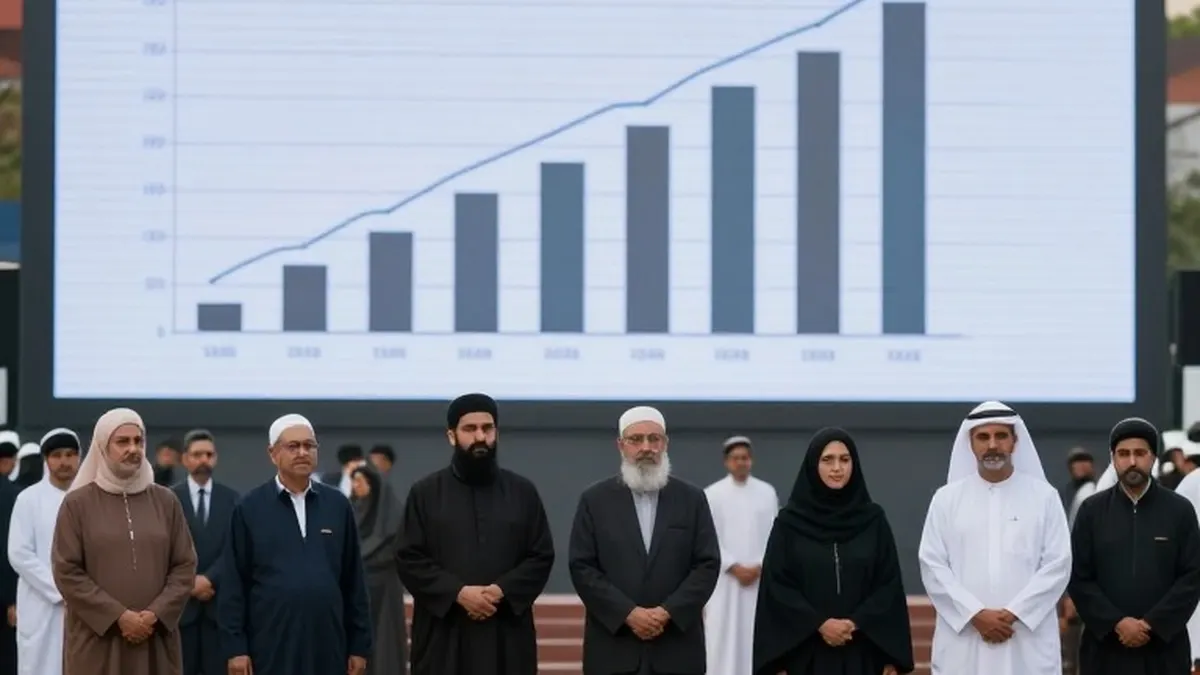
The Pew Research Center has released a new projection stating that Islam is on track to become the world's largest religion by the middle of the next decade. This shift is primarily driven by higher birth rates among Muslim women compared to women of other faiths. For centuries, Christianity has held the position of the dominant global religion, but the Muslim population has been expanding at a significantly faster pace.
According to the study, the global Muslim population is forecast to reach 2.57 billion by the year 2035. In the same period, the number of Christians is projected to be 2.52 billion. This data marks a pivotal moment in global demographics where the two major faiths will effectively swap their historical rankings.
The report attributes this demographic transition largely to differences in fertility rates. During the period from 2020 to 2025, the average number of children born to Muslim women was 3.1. In contrast, Christian women averaged 2.5 children. These figures are significantly higher than the minimum rate of 2.1 children per woman required for a generation to replace itself without population decline.
If current trends continue, the gap between the two religions will widen considerably over the next half-century. By 2070, Muslims are expected to number 3.6 billion, while Christians will total 3 billion. At that time, Islam will account for 37% of the global population, up from 26% in 2020. Christianity is expected to hold steady at approximately 29% of the world's population, maintaining its position as the second-largest faith.
While natural population growth remains the primary driver of these changes, religious switching also plays a role. Pew notes that both Islam and Christianity will lose more adherents to other religions than they gain from them. However, the net loss for Muslims is projected to be much smaller. Between 2020 and 2070, Islam is expected to lose 8 million followers to switching, whereas Christianity is projected to lose 105 million.
The overall world population is set to increase by 29% during the period from 2020 to 2070. Islam and Christianity are the only two religious groups forecast to match or exceed this growth rate. Islam will expand by 80%, while Christianity will grow by 30%. Other major religions will experience different trajectories during this timeframe.
Hinduism is expected to see growth in absolute numbers, but its share of the global population will slightly decrease to 13.6% by 2070. Judaism will follow a similar pattern, with its global share projected to be 0.17%. Buddhism is forecast to decline in both total numbers and percentage of the population, dropping to 2.5% by 2070. Smaller faiths, including Baha'i, Daoism, Jainism, and Sikhism, are expected to see modest numerical rises but will collectively represent less than 2% of humanity.
People with no religious affiliation, including atheists and agnostics, are expected to decline sharply as a proportion of the global whole. This group currently makes up 24% of the world's population but is projected to fall to 17% by 2070. This decline is driven by shifting geographic distributions and population changes in specific regions.
The geographic center of gravity for Christianity is also shifting. By 2070, Christianity will remain the largest religion in the United States but will no longer hold a majority. The Democratic Republic of Congo is projected to surpass the US as the country with the largest concentration of Christians. Meanwhile, the number of religiously unaffiliated people is expected to grow in most countries, though this increase will be offset by the shrinking population forecast for China, where the majority of the world's non-believers currently reside.