Ancient Comet Dust Creates Rare Night Sky Spectacle
Photographers in the southern United States are documenting a meteor shower powered by debris from a comet that is currently billions of miles away.
By Olga Menon ·
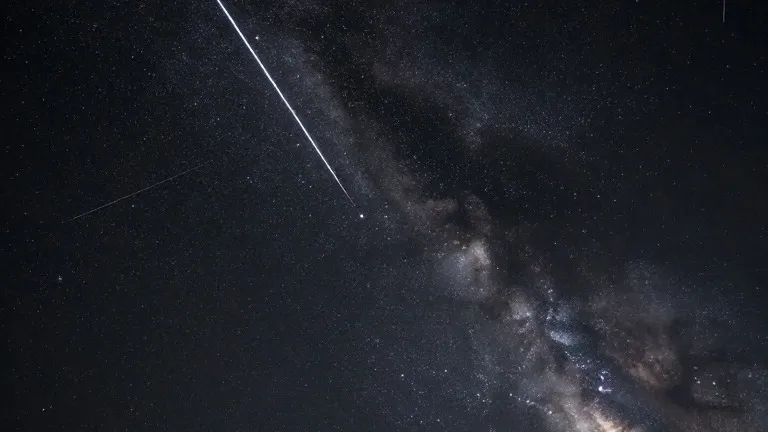
The visual disconnect between a distant celestial body and its immediate earthly effect defines the current astronomical event. Although the source of the phenomenon is located far beyond the reach of even the most powerful telescopes, its remnants are now creating a vivid display in the lower atmosphere. This tension between distance and visibility has resulted in one of the most striking astrophotography opportunities of the season for observers in the northern hemisphere.
The primary driver of this activity is Comet 1P/Halley, a well-known periodic comet that is currently situated more than 3 billion miles from Earth. Despite this vast separation, the particles the comet shed during its orbit continue to intersect with our planet’s atmosphere. When these fragments burn up at high speed, they produce the glowing trails that define the annual Orionid meteor shower. The event serves as a tangible reminder of the comet’s historical path through the solar system, long after the icy nucleus has moved on to the outer edges of the planetary system.
A specific instance of this activity was documented in the early hours of October 21 by astrophotographer Tim McCollum. Working from Toccoa, Georgia, McCollum captured three distinct meteors between 3 a.m. and 4 a.m. local time. The image reveals the meteors radiating outward from a specific point in the sky, a visual effect known as the radiant. In this case, that origin point lies in close proximity to Betelgeuse, a prominent red giant star within the constellation Orion. This alignment helps skywatchers identify the shower’s direction and activity level.
Capturing such fleeting events requires a combination of technical precision and favorable conditions. McCollum utilized a Canon EOS Ra camera paired with an RF 28-70 f2.0 lens to record the scene. To ensure the stars remained sharp while the meteors streaked across the frame, he employed a star tracker to keep the camera locked on the radiant. The final image is a composite created by merging multiple 30-second exposures using PixInsight software. This technique allows for the preservation of detailed background star fields while clearly illustrating the motion of the faster-moving meteors.
The photograph extends beyond the meteor trails to showcase significant features of the autumn sky. On the right side of the frame, the stars of Orion’s Belt are visible, situated near the luminous Orion Nebula. This nebula is one of the closest major star-forming regions to Earth, making it a key landmark for amateur astronomers. Additionally, the image includes the Rosette Nebula, designated as Caldwell 49, which is embedded within the dense starfields and dust lanes of the Milky Way’s galactic plane. The diagonal orientation of the galactic band across the composite adds depth to the scene, highlighting the richness of the star clusters present in that region of the sky.
For those interested in observing the shower directly, the activity is not yet at its maximum potential. The Orionid meteor shower remains active until November 7, providing several more nights of opportunity for visual observation. As the days progress toward the peak, the frequency of visible meteors is expected to increase. This window allows for a more robust sampling of the debris stream, increasing the likelihood of witnessing brighter and more frequent events compared to the earlier dates of the season.
There is an additional layer of complexity for observers during this specific period due to the overlap with another meteor shower. Earth is currently passing through debris streams associated with Comet 2P/Encke, which generate the Taurid meteor shower. The convergence of these two streams can sometimes result in the appearance of the so-called Halloween Fireball. These are exceptionally bright meteors that can occur during this overlapping window, adding an element of surprise and intensity to the typical Orionid activity. This dual-source activity makes the current nights particularly significant for both visual watchers and photographers.
The broader context of this event highlights the ongoing relationship between cometary orbits and terrestrial weather in the sky. While the comets themselves are distant, their legacy in the form of dust and debris continues to shape our visual experience of the night. As the season progresses, the interplay between these astronomical sources will define the meteor activity for the remainder of the autumn. Observers are encouraged to monitor the skies during the coming weeks to capture the full scope of this annual celestial phenomenon.